· ReadyStack
Worked example
Real numbers from this tool, line by line.
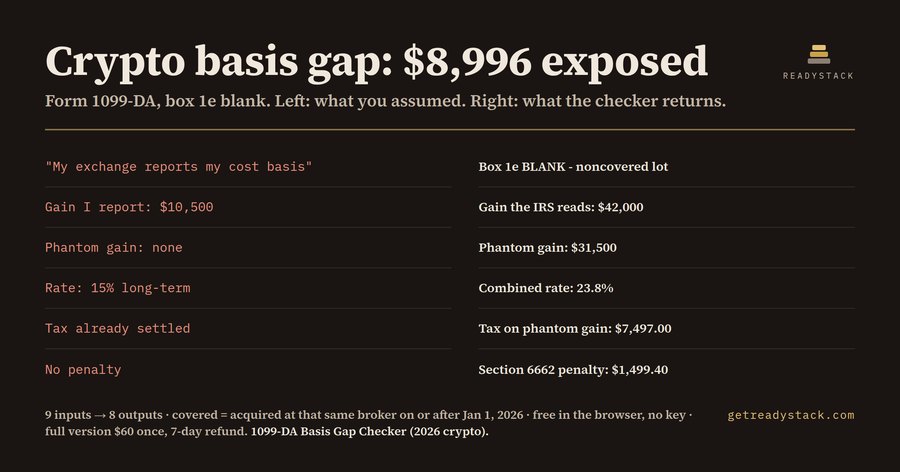
$8,996.40 of tax and penalty on one crypto lot - US crypto investors who moved coins off an exchange before selling in 2026. That is what the checker prints, eight outputs on one screen:
| Output | Result |
|---|---|
| What box 1e will say | Box 1e BLANK - noncovered lot |
| Your true gain | $10,500 |
| Gain the IRS reads off the form | $42,000 |
| Phantom gain | $31,500 |
| Combined rate on the phantom gain | 23.8% |
| Tax on the phantom gain | $7,497.00 |
| 20% accuracy-related penalty, section 6662 | $1,499.40 |
| Total exposure on this one lot | $8,996.40 |
The nine inputs behind that table: a lot transferred in from self-custody; sold in 2026 for $42,000 gross proceeds; documented cost $31,500; held more than a year; 15% long-term band; 24% ordinary rate, unused because the sale was long-term; 5% state rate; net investment income tax applying; records not substantiated. The combined rate stacks to 23.8% - 15 federal, 5 state, 3.8 net investment income tax - and it lands on the phantom gain, not on the real one.
Now flip the one input that matters. Change the origin to a lot bought at that same broker on or after January 1, 2026 and held there. Box 1e is filled by the broker, the phantom gain is $0, total exposure is $0. The gap is not about the size of your trade. It is about whether the broker watched you acquire the coin.
Here is why. Starting with the 2026 tax year, custodial brokers must report cost basis on Form 1099-DA - but only for covered digital assets. An asset is covered only if it was acquired at that same broker on or after January 1, 2026 and held continuously in that account until the sale. Every other lot is noncovered, and no exception lets a transfer statement carry basis from one broker to another the way it does for stock. The moment a coin moves - exchange to exchange, or into a hardware wallet - the chain breaks.
Noncovered means box 1e is blank. Your gross proceeds still go to the IRS. Your basis does not. The automated underreporter that matches forms against returns sees proceeds with nothing subtracted, which is how a $10,500 gain is read as $42,000.
A second rule compounds this one. Rev. Proc. 2024-28 ended the universal cost basis method: since January 1, 2025 basis is tracked per wallet. One pooled spreadsheet is now the wrong shape, exactly when a blank box 1e makes your own records the only thing standing between you and the matcher.
A chatbot will not warn you: the models answer from the stock world, where basis follows the security across a transfer. Your exchange will not warn you: its gain/loss report is built from its own ledger and has no idea what the coin cost you somewhere else. Both are confidently wrong in the same direction - they tell you the broker knows.
The checker runs in the browser, nothing you type leaves the page, and every calculation is free with no key and no limit. The paid tier does not gate the answer; it changes axis. The $60 licence exports every lot you checked into a CSV basis-substantiation worksheet you own and hand to your preparer, and sets reminders for the December 31, 2026 close of the tax year and the February window when forms land. A US CPA bills $150 to $400 an hour for this reconciliation, and answering one CP2000 notice is normally three to six hours. Price one lot before year-end: if it comes back zero you learned that in 15 seconds, and if it comes back $8,996.40 you still have time to rebuild the records.
Questions people ask
What does the 1099-DA Basis Gap Checker actually do?
You describe one 2026 crypto sale: where the lot came from, the gross proceeds, your own cost basis, the holding period and your rates. It tells you whether your broker will print a cost basis in box 1e or leave it blank, and prices the tax and penalty that blank exposes if the IRS reads the sale as all gain.
Who is this for?
US crypto investors who moved coins between exchanges or into a hardware wallet before selling in 2026, and the bookkeepers and enrolled agents who clean up after them. It is aimed at anyone who will get a Form 1099-DA in early 2027 for assets their broker did not watch being acquired.
Why will a free chatbot or my exchange's gain/loss report not tell me this?
Both assume your broker knows your basis. For 2026 a digital asset is covered only if it was acquired at that same broker on or after January 1, 2026 and held there until sale. Transferred-in lots are noncovered, no transfer statement carries basis across, and box 1e simply stays blank.
What is free and what does the paid version add?
Every calculation is free, forever, with no key, no watermark and no limit on how many lots you price. The paid version changes axis rather than depth: it exports the lots you checked to a CSV basis-substantiation worksheet you own, and sets the year-end and 1099-DA arrival reminders.
What would this cost me if I hired someone instead?
A US CPA bills roughly $150 to $400 an hour for crypto basis reconciliation, and drafting the response to a single CP2000 matching notice is normally a three to six hour engagement. The full version is $60 once,.
Ask about this tool
One question, answered by the person who built it. Your email only if you want the answer sent.